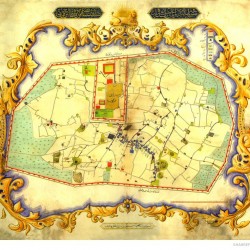
Six Old Maps of Tehran (1848-1925)
Six maps of the Tehran and Suburbs in Qajar period (1848 to 1925).
(Source: Nimrooz) – To see the details in the maps click on the images, hold down your mouse button, and move the pointer over the image.
✤ Also available in:



Six maps of the Tehran and Suburbs in Qajar period (1848 to 1925).
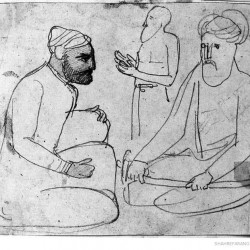
Unlike some other Western painters of the 19th century Jean Auguste Dominique Ingres never went to the East. His sketches of Persian miniatures are to make the décors in some of his “oriental” works as exotic as possible. Here are seven of such drawings which are now kept in Ingres Museum, Montauban, France.
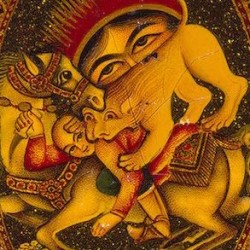
Ganjifa and Aas-Naas are traditional Iranian card games whose history goes back to the 15th century Safavid period. Apparently Ganjifa was similar to Hokm and Aas-Naas to Poker. These hand-painted playing cards are all from the late Qajar period and are made of lacquered papier-mâché.
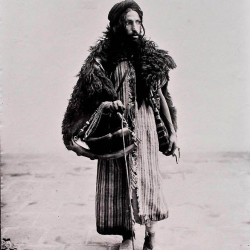
Dervishes were a common subject for foreign photographers of the late Qajar period. These photographs helped to create and fed the stereotypes of exotic Easterners, but nevertheless they are useful historical records of the period.
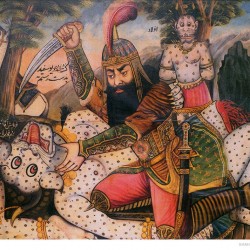
For ages the battle of Rostam and White Deev has been one of the most popular subjects among Iranian book illustrators, tile-makers, and coffee-house painters.

A collection of movie advertisements from the 1910s to the 1930s in Persian, Russian, and French.
![Th[o/e]se Days](https://dev.shahrefarang.com/wp-content/uploads/2012/06/Those-Days-10-250x250.jpg)
“Th[o/e]se Days” is a new collection of photos by Shahin Shahriari & Sina Bagheri. For this collection, they had used pictures of the Iranian Revolution of 1979 and merged them with the new shots of the same spots in Tehran today.
For this collection the photographers used pictures of the Iranian Revolution of 1979 and merged them with the new shots of the same spots in Tehran today.
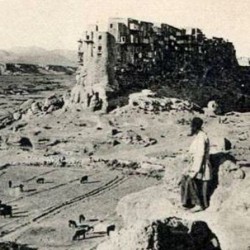
The stereoscopic pictures here are European postcard published in early 20th century. Stereoscopy refers to a technique for creating the illusion of depth in an image by presenting two offset images separately to the left and right eye of the viewer.